america's best baseball card game!
The Federal League's Greatest Star: Benny Kauff
Blog post description.
12/9/20254 min read
The Federal League's Greatest Star: Benny Kauf
The Federal League of Base Ball Clubs, known simply as the Federal League, was an American professional baseball league that played its first season as a minor league in 1913 and operated as a "third major league" in competition with the established National and American Leagues from 1914 to 1915.
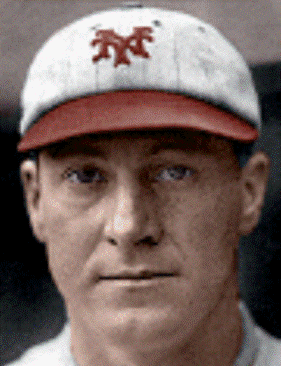
One of it greatest stars was Benny Kauff who played for the Indianapolis Hoosiers. Primarily a center fielder, he easily led the League in runs (120), hits (211), on-base percentage (.447), and stolen bases (75), and his .370 batting average topped his nearest competitor by more than 20 points.
As Kauff propelled the Hoosiers to the pennant, the press began referring to him as "The Ty Cobb of the Federal League." Off the field, Kauff was a flashy dresser who wore the latest clothing styles along with diamond rings and fancy tie pins which matched his robust ego.
After the 1914 season, the Federal League’s Indianapolis franchise shifted to Newark, but Kauff found himself transferred to the Brooklyn Tip Tops as repayment of the outgoing Indianapolis owner’s old debts. Kauff thought he should have been a free agent, so he negotiated a three-year contract with the National League's New York Giants in April 1915. However, NL President John Tener promptly voided the contract.
Exiled to Brooklyn, Kauff again played brilliantly, leading the Federal League with a .342 batting average, .446 on-base percentage, and .509 slugging percentage, while swiping a league-best 55 bases. That performance only increased the Giants desire to land the star. When the Federal League folded following the 1915 season, Kauff applied for and received reinstatement into organized baseball, then inked another contract with the Giants.
Kauff was a minor disappointment in his first year in New York. Playing center field every day, Kauff's sported an unimpressive .264 batting average yet even so, he had a talent for getting on base. His nine home runs and 15 triples that season went along with an aggressive base running style that produced 40 stolen bases. Kauff played much better in 1917 and 1918, as he batted over .300 each season. In the 1917 World’s Series, his two home runs helped New York win a Game Four victory.
Kauff put forth another good season in 1919, finishing second in the NL in home runs with 10 and fourth in RBI with 67. But despite Kauff’s efforts, the Giants never seriously challenged for the pennant, finishing a disappointing nine games out of first place.
Additionally, two NY Giants regulars, Hal Chase and Heinie Zimmerman, decided to start fixing games and tried to bribe other teammates to help them, including Kauff, who reported the attempt to manager John McGraw. Despite that act of integrity, rumors of Kauff’s own dishonesty soon began to surface. Billy Maharg, one of the conspirators who helped fix the 1919 World’s Series, later claimed that Kauff had participated in that scheme though he never really proved "how."
To make matters worse, in February 1920 Kauff was indicted on auto-theft charges in connection with the Manhattan automobile accessory business he had started the previous fall with his half-brother, Frank Home, and Giants teammate Jesse Barnes. In the complaint, authorities alleged that Kauff and two associates stole a vehicle from a West End Avenue parking lot, then fitted it with a new paint job, tires, and a license plate before selling it to an unsuspecting customer for $1,800. Kauff denied the charges, contending that he was unaware the car was stolen when he re-sold it.
At the start of the 1920 season with his legal problems still pending, Kauff reported for duty with the Giants. But manager McGraw who wanted to distance himself from any controversy grew reluctant to play his talented center fielder and finally traded him to the Toronto Maple Leafs of the International League in early July. In the half-season he spent in Toronto, Kauff batted .343 and stole 28 bases and was expected to return to the Giants the following season.
MLB Commissioner Keneshaw Mountain Landis, however, had other ideas. Landis ruled that the Giant center fielder would be ineligible pending resolution of the criminal matter. The trial finally began in early May and lasted five days. The state’s chief witnesses were Kauff’s two associates, both ex-cons, who claimed they helped Kauff steal the automobile. The defense countered that Kauff had been eating dinner with his wife at the time of the alleged incident, then brought out a series of character witnesses, including McGraw and teammate George Burns to defend Kauff’s reputation. The jury deliberated for less than an hour before returning with a not-guilty verdict.
After his victory in court, Kauff expected that he would be quickly reinstated into the National League. He was in for a surprise as Commissioner Landis refused to lift the ban as he felt Kauff was an overall bad influence. Stunned by Landis’ decision, Kauff applied to the New York State Supreme Court for a permanent injunction against his banishment. But all hope for reviving his career ended in January 1922 when the court concluded it had no grounds to act on Kauff’s request.
His playing career over, Kauff lived out much of the rest of his life in Columbus, Ohio, with his wife, Hazel, and the couple’s only child, Robert. Kauff kept in baseball as he subsequently worked for 22 years as a scout.