america's best baseball card game!
Ruth Suspended For Barnstorming
Blog post description.
12/9/20252 min read
Ruth Suspended For Barnstorming
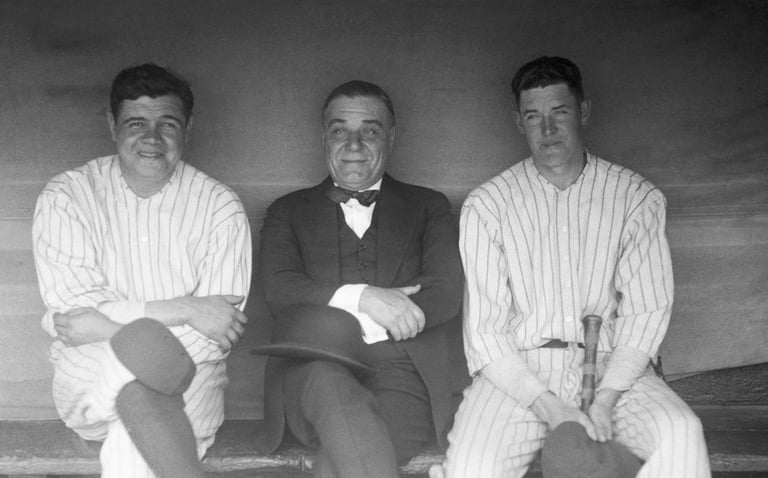
Babe Ruth’s 1921 World Series was disappointing mainly due to an infected boil that limited his playing time to five games and one pinch-hitting attempt. Needless to say, the Yankees lost the series to the Giants in eight games. With the Series done and Ruth's contract up, he decided to tour for cash until he could negotiate a new deal.
Yankee players had received a letter from MLB Commissioner Kenesaw Mountain Landis to avoid "barnstorming." In those days playing extra exhibition games especially in cities where there was no major league baseball team was a lucrative after season paycheck.
It was therefore not totally surprising when The Bridgewater Courier-News reported on an upcoming game featuring Babe Ruth and other Yankees playing for the Carl Mays' All Stars against the Meadowbrooks in Newark.
But many of the Yankee players began to reconsider their involvement after Landis made several statements to the press reinforcing his ban against barnstorming. This directly lead to the cancellation of the game in Newark.
However, Ruth because of his stature as the premier baseball star and crowd draw was not intimidated. He simply regrouped and encouraged other pro players such as Bill Piercy, Bob Meusel and Tom Sheehan to continue on the tour. The Ruth team was soon scheduled to play a squad named “the Polish Nationals,” in Buffalo, New York.
Ruth believed the barnstorming ban was unjust as it had not been enforced consistently for years. When he previously was on the Red Sox, Ruth had been fined $100 for barnstorming after 1916 World Series. But major league baseball soon began to ignore barnstorming and in fact no punitive action had been taken by the either the American or National Leagues in 1919 and 1920.
In 1921, Landis stated that the "No Barnstorming" rule must be enforced for championship teams though strangely players on teams that did not play in the World Series were allowed to continue the practice. Perhaps the bigger issue was that Landis had an ego that paralleled that of the Babe. Understandably in that context Landis ultimately viewed Ruth as a threat to his power.
Landis also had to contend with several major league team owners who were adamantly against barnstorming. Many owners who held racist beliefs objected to frequent games against teams composed mainly of Negro players. Other owners were against barnstorming because they felt it better financially prepared players for attempts at unionization. Still other thought barnstorming might ultimately lead to a renegade league.
The game in Buffalo was moved to a less than perfect venue and fewer fans attended than expected with the $4,500 guarantee of the promoter not met. Piercy pitched, Meusel played shortstop, Sheehan covered right field, and Babe played first base with bandaged elbow. Ruth and Meusel hit back-to-back homers in the 6th and the barnstormers won 4-3.
Ruth and the others then played in Elmira and Jamestown, New York. Ruth leveraged his popularity and baseball skills by hitting two home runs and admitting young boys for free in Elmira. The team also won in Jamestown in a rainy game where Ruth got two doubles but no homer. With a couple of other additional stops, the tour ended less than a week later.
Regardless, the infuriated Landis fined both Ruth and Meusel $3,500 and gave each a six-week suspension. Fans begged Landis to reconsider but he didn't respond. Ruth rested in Hot Springs, Arkansas, before signing a $52,000 contract with the Yankees. On May 20, 1922, Ruth and Meusel returned to the Yankee's lineup with a warm welcome from 40,000 fans at the Polo Grounds. Ruth was given silver items and a floral wreath in the shape of a baseball diamond.