america's best baseball card game!
Old Baseball Park Quirks
Blog post description.
12/9/20253 min read
Old Baseball Stadium Quirks
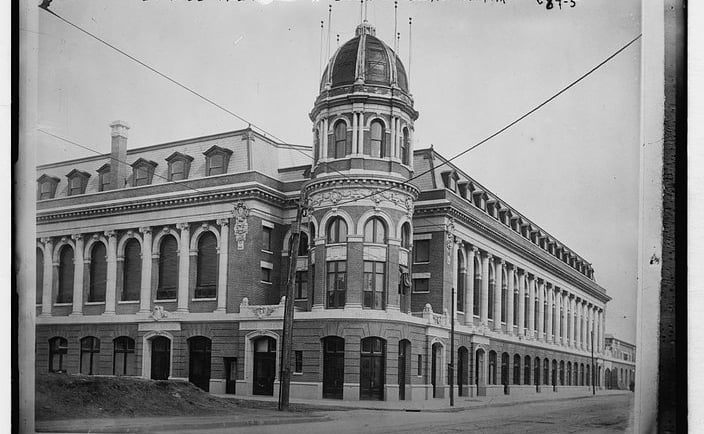
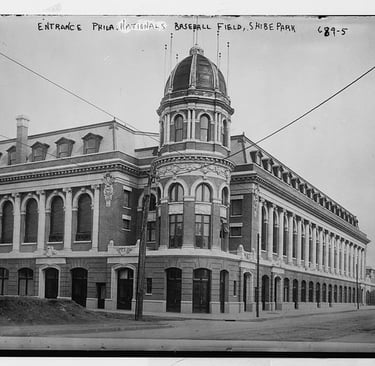
Baker Bowl in Philadelphia | 1904-1938
The Baker Bowl, the original home of the Phillies was rebuilt with steel and concrete in 1895 after the original Baker Bowl composed mostly of wood was destroyed in a fire. Because of these modifications, the stadium is commonly referred to as the first “modern” ballpark.
The Baker Bowl was known for its towering 40-foot-high right field wall. The wall feature was built because the right field corner was only 279 feet from home plate which made it a desirable target for left-handed hitters. In 1937, the right field wall was increased to 60 feet, which made it even higher than the famous, 37-foot "Green Monster" in left field at Boston's Fenway Park.
Polo Grounds in New York | 1911-1963
The Polo Grounds had an incredibly deep center field (403 to 505 feet) but it was extremely shallow and home run-friendly down the lines (276 feet in left and only 258 feet in right).
The original site of the Polo Grounds actually bordered Central Park in Manhattan. In proximity to the baseball park was an area where polo was played by some of New York City's rich elite, hence the name Polo Grounds. The name stuck even when a new Polo Grounds was built farther uptown, at Coogan’s Hollow.
Capacity was just 16,000 when the new ballpark opened. The New York Giants played there until they moved to San Francisco in 1958. The Yankees moved into the Polo Grounds in 1913 though after the team purchased Babe Ruth from the Boston Red Sox, the Giants became the less popular team in their own ballpark. In 1920, the Yankees drew 1,289,422 at the Polo Grounds, more than 300,000 more fans than the Giants. Soon thereafter the Giants informed the Yankees that their presence was no longer welcome which prompted the team to build Yankee Stadium in 1923.
Many baseball fans don't remember that the New York Mets actually played at the Polo Grounds from 1962-63.
Tiger Stadium in Detroit | 1912-1999
Tiger Stadium had a right field seating area that hung 10 feet over the actual playing field. This oddity was due to the fact that there was limited room for outfield seating as a city street butted up against the ballpark. Tiger Stadium had other quirks. A tall flagpole in center field, a few feet from the outfield wall, was in fair territory and a was a hindrance to outfielders. Pillars holding up the upper deck obstructed the view of fans from many outfield seats.
Forbes Field in Pittsburgh | 1909-1970
Forbes Field was actually named after General John Forbes of the French and Indian War fame. The walls were so far back at Forbes that it was assumed that no outfielder would ever crash into one chasing a deep fly. With that strategy in mind, there was little thought about placing objects in front of the walls. This included a flag pole, located on the center field warning track, and the batting cage, at the 457 marker left of center. When lights were installed in 1940, three of its towers were planted into the ground in front of the outfield wall, from left to center—with cages placed around them which supposedly would protect outfielders. After the stadium was torn down, one outfield wall was left intact and still stands.
Braves Field in Boston | 1915-1953
Braves Field had a center field wall that was a staggering 550 feet from home plate and was lined with fir trees to hide the smoke from a nearby railyard yard. The other outfield walls were almost as intimidating in their distance. The deep center field made this stadium a hotbed for inside-the-park home runs. The year the stadium opened, 1915, only 13 home runs were hit there—all of them inside the park. It wasn’t until 1917 when the Cardinals’ Walton Cruise became the first to finally send one over the relatively less distant right-field wall. Four years later, he became the second. Over in left field, the wall remained unconquered; no one had even hit it on the fly until 1921. Finally, in 1925—10 full years after Braves Field had opened—the New York Giants’ Frank Snyder became the first to clear the barrier.