america's best baseball card game!
Move The Baseball HOF To Hoboken, NJ
Blog post description.
12/11/20252 min read
Move The Baseball HOF To Hoboken, NJ
Why the Baseball Hall of Fame is located in Cooperstown, New York, is mostly based on the myth that revolves around Abner Doubleday as the inventor of baseball. In reality, we should be visiting the HOF in Hoboken, New Jersey. Uh, Hoboken? Well, yes!
This is primarily because Alexander Cartwright, who as a founding member of the New York Knickerbockers Base Ball Club in the 1840s is often referred to as the “Father of Modern Baseball.” With that said, even his role in the development of baseball is in dispute though unlike Doubleday, he did at least play the game. On the affirmative side, many baseball historians point to the Knickerbocker Baseball Rules that evidently Cartwright and others wrote down.
So, this brings us back to Hoboken. The Knickerbockers chose Elysian Fields in Hoboken as their practice site beginning in 1845. Why, did a band of New Yorkers choose Hoboken? Even in those early times (before the development of Central Park), New York City was crowded with few open spaces. By the way, Elysian Fields was also close to a popular tavern. Guess beer and baseball go back a very long way.
Hoboken was also a cheap bargain. For a round-trip fare of 13 cents Cartwright’s players and their fans could take a ferry directly to the site and for an additional fee of $75 per year, the team gained full access to the field along with a detached locker room.
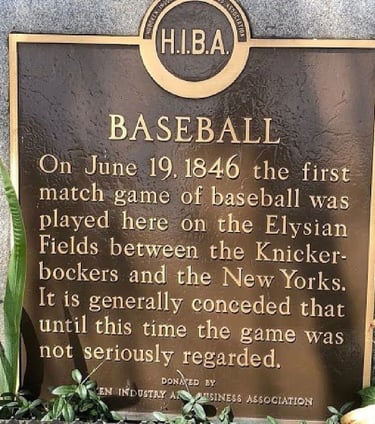
On June 19, 1846, the Knickerbockers played their first game against another team, the New York Baseball Club who thrashed them 23-1. This was the first clearly documented match between two different clubs under the new rules which soon became known as the “New York Rules.” Some years later in 1865, a championship game was played at Elysian Fields before a crowd of 20,000. This event was commemorated with the etching of a famous Currier & Ives print that most of us have probably seen.
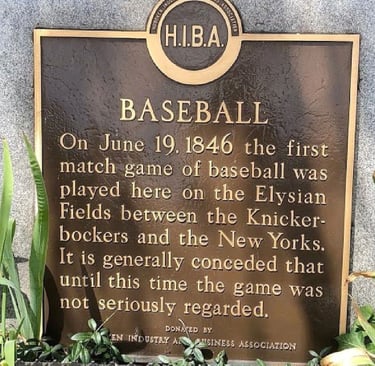
By the 1860s there were many baseball venues in New York City particularly in the Brooklyn Burrough and the popularity of Hoboken drastically declined. In fact, the last professional game there occurred in 1873. Over time Elysian Fields became a World War I weapons factory then a Maxwell House coffee mill. Fast forward to the 20th Century as Hoboken became mostly known as the birthplace of Ol’ Blue Eyes himself, Frank Sinatra. The baseball connection was almost an afterthought and the site is now blanketed with luxury condos. Only a bronze monument remains which is set back fifteen feet from a busy road almost hidden in the well-manicured landscape next to a dog run.
Hoboken most rightly deserves better than a simple marker for its importance to the game of baseball but regrettably that small almost obscure recognition is probably the only mention it will ever get.