america's best baseball card game!
Harold Arlin & The First Radio Broadcast
Blog post description.
12/11/20253 min read
Harold Arlin & The First Radio Broadcast
Today there are television cable channels devoted to each Major League Baseball team. Then add on the MLB Network, ESPN, Fox Sports, even Facebook and Apple TV. It’s no wonder that radio stations that still broadcast baseball games are actually struggling to maintain an audience. Most of their listeners for whatever reason can’t get to a TV or don’t have the right app on their cell phone. Perhaps, they just can’t focus on an all-absorbing screen while doing a chore like mowing the yard, driving a car or typing on a keyboard. Otherwise, they would be watching, who wouldn’t, right?
Well, once upon a time in a much simpler world before anyone had ever dreamed of television, things were very different. In fact, even the lowly radio was in its infancy. It wasn’t until 1896 that Guglielmo Marconi received his famous patent to “…transmit electrical impulses and signals to an apparatus there-for.” This was of course the first practical attempt to harness the Hertzian wave (radio wave).
It took a few more years (the year 1912 in fact) before Marconi left Italy and ended up running a radio factory in Chelmsford, England. And then a few more years before the device began to show up in American homes. Yet in the early 1920s, the radio still was a novelty of sorts and out-of-the-reach financially for the average wage earner.
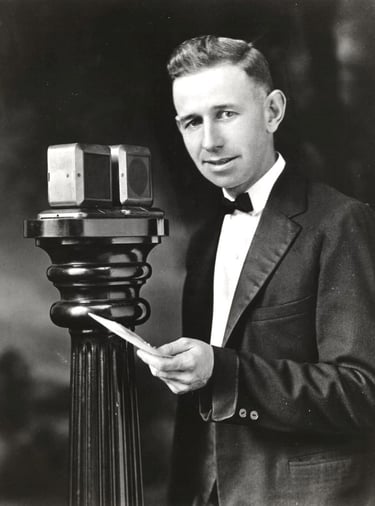
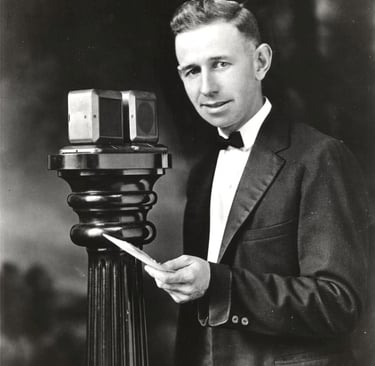
The first baseball broadcast was on August 5, 1921, when a 25-year-old electrical engineer by the unassuming name of Harold Arlin sat behind home plate in Pittsburgh’s Forbes Field and delivered the game’s play-by-play. It was only by chance that Arlin fell into this role as no one else seemed available or wanted to do it.
Arlin’s audience was a handful of radio enthusiasts who could listen to KDKA—not only the first radio station in Pittsburgh but the first commercial radio station in the United States.
Of course, not much is known about the broadcast as there was no technology to record it at the time. However, what we do know is the score as the home team beat the Phillies 8-5. We also know that Arlin spoke into a buggy radio microphone that was actually called a “mushiphone” aptly named because it looked like a “mushroom with a felt lining.” It was said that fans sitting in the stands around Arlin were completely mystified at the spectacle and didn’t quite know what to make of the man evidently talking to himself the entire ballgame.
It is also interesting to note that the following day after his historic baseball broadcast, Arlin was at it again this time broadcasting a Davis Cup match between Great Britain and Australia in Pittsburgh—the first tennis event ever on radio.
Then two months later, Arlin announced the first college football game broadcast on radio as the University of Pittsburgh battled West Virginia on their home turf. Evidently, Arlin became a legend of sorts (and why not with all his “firsts”) as years later he was donned with the title of America’s first-ever disc jockey which is a misnomer of sorts as he never played a record while at the microphone.
Continuing with his radio gig, Arlin soon thereafter also interviewed Babe Ruth who was so awe-struck by the technology that the normally loquacious ballplayer couldn’t speak coherently. Instead, he mostly let Arlin describe his on-the-field exploits while smoking a cigar.
But soon Arlin decided to abandon his record setting radio career and settle down into a more mundane job with Westinghouse (the parent company of KDKA). He found himself once again avoiding his electrical engineering background this time for a career in public relations and promotions of the Westinghouse brand of household appliances.
Strangely, Arlin was brought back into the radio booth almost 50 years later on August 30, 1972, when he took a guest role to broadcast the appearance of his grandson, Steve Arlin, a pitcher for the San Diego Padres.
O.K. back to our radio story. One would imagine that baseball in an attempt to further its sports dominance at the time would have embraced the radio broadcast with open arms. Curiously, the opposite was true as owners felt that fans listening at home on the radio would never want to come to the ballpark to watch a game in person. This same self-serving reasoning was later used by baseball owners with the advent of television.
It took until 1939 before all Major League Baseball teams had local radio broadcasts of their games. As Harry Caray would often say, “Holy Cow!”