america's best baseball card game!
Ever Heard Of the 1889 Baseball Players League?
Blog post description.
12/11/20253 min read
Ever Heard Of The 1889 Baseball Players League?
Have you ever heard of the Players’ National League of Professional Base Ball Clubs (usually referred to simply as “The Players League”)? Not many baseball fans have.
Let’s go back in history a bit. American professional baseball began in 1871, with the National Association of Professional Ball Players (not to be confused with the Players League). In fact, even two years earlier the Cincinnati Red Stockings had come on the scene by paying salaries to ten of their best players. Then in 1876, the National League was created absorbing most of the teams from the National Association of Professional Ball Players which had folded.
OK, back to the Players League. It was a short-lived but star-studded league formed in 1889. It gained momentum due to a dispute with ballplayers and who else—the club owners. At the core of the labor tension was an owner’s internal agreement put in place in 1879 that limited ballplayers from the ability to negotiate salaries across the various teams in both the National League and the American Association (the two leagues at the time). Sound familiar? This restriction eventually morphed into baseball’s infamous reserve clause, remember Curt Flood?
Both leagues had set a salary cap for all players at $2,000 with various levels of compensation based on a crude player ranking system. Although the Players League was started by the players themselves, the players were most generally better on the ball field than in the front office and control of several of the teams actually was transferred to private owners outside of the player pool.
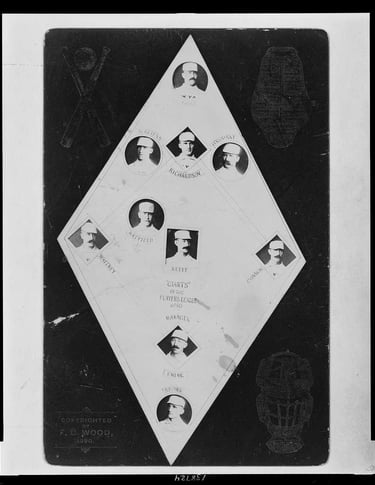
Most of the best players to migrate to the Players League came from the National League such as the most popular star of the day, John Montgomery Ward. Others were Roger Connor, Pete Browning, Hardy Richardson, Pub Galvin, Mike “King” Kelly, Charles Comiskey (yea it’s that Charles Comiskey) and pitchers Mark Baldwin, Tim Keefe and “Silver” King. By the way, Connor was the league leader in home runs with 14 while Pete Browning lead in batting average at .373. On June 21, 1889, King threw an eight-inning no-hitter.
The clubs were as follows: The Boston Reds (which eventually won the league championship), Brooklyn Ward’s Wonders, New York Giants, Chicago Pirates, Philadelphia Athletics, Pittsburgh Burghers, Cleveland Infants (yes Infants not Indians, strange eh?) and Buffalo Bisons. Most teams played at least 130 games.
Games generally were well-attended. An Opening Day game with Philadelphia at New York City was jammed with more than 12,000 fans. Unfortunately, even with bodies through the turnstiles most owners lost money and began to get cold feet about the sustainability of the league. This was compounded by the fact that the league directly competed with the National League and American Association in some cities where often two professional baseball games were going on at the same time. In this scenario all teams no matter the league felt the glut and suffered.
There was little momentum to continue the following season and several of the teams were absorbed back into the National League or American Association which had deeper financial pockets.
It has been said that one of the benefits resulting from the Players League was the construction of new baseball stadiums the most prominent of which was New York's Polo Grounds. Additionally, in 1968, the MLB's Special Baseball Records Committee determined the Players League was indeed a "major league" for statistical purposes and all records could be counted as official.
Ironically, the Players League had no immediate or long-lasting effect for the betterment of the ball players. Things reverted back to the status quo as far as salaries went when the players returned to the National League and American Association. That struggle would take almost another 100 years or so to change with the end to the reserve clause and the rise of free agency.