america's best baseball card game!
Dutch Leonard: "Ty Cobb's Bolshevik"
Blog post description.
12/9/20254 min read
Dutch Leonard: "Ty Cobb's Bolshevik"
In the history of Major Legue Baseball there have literally been thousands of players who had nicknames. "Lefty," "Kid," or "Chief" are some of the most common. Then there are those of a more unusual nature such as "The Iron Horse" (Lou Gehrig), "The Fordham Flash" (Frankie Frisch) or "Rajah" (Rogers Hornsby). Yet there is one nickname that is perhaps the strangest of all and tells a tale of an extremely strained relationship between two players like no other.
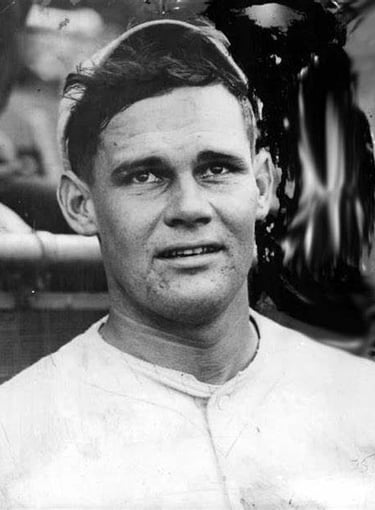
Hubert Leonard more usually known as "Dutch" Leonard (his first and most recognizable nickname though we will explore another in this article) was an American League left-handed pitcher who had an extraordinary 11-year career from 1913 to 1921, and 1924 to 1925.
Leonard played for the Boston Red Sox and Detroit Tigers. He debuted with the Red Sox in 1913 and the following year he lead the American League with a remarkable 0.96 ERA--the MLB record for a single-season. Leonard pitched well in Boston's 1915 and 1916 World Series victories. He won Game 3 of the 1915 World Series, out dueling the Phillies' Grover Cleveland Alexander 2–1. He also won Game 4 of the 1916 World Series against the Brooklyn Robins. Additionally, Leonard pitched two no-hitters for the Red Sox, the first in 1916 against the St. Louis Browns and the second in 1918 against the Detroit Tigers.
In January 1919, the Red Sox sold Leonard to the same Detroit Tigers where Leonard subsequently played from 1919 to 1921 and 1924–1925. Unfortunately, Leonard immediately became embroiled in a salary dispute with Tigers' owner Frank Navan and he opted to play for Fresno in the San Joaquin Valley League in 1922 and 1923. Leonard was suspended by the American League for his actions, but he rejoined the Tigers in 1924 where he began feuding with Tigers manager Ty Cobb.
Even before their player-manager problems, Leonard and Cobb had a bad history. In 1914, Leonard hit Cobb in the ribs with a fastball. In the next at bat, Cobb dragged a bunt which the Red Sox first baseman was forced to field. As Leonard's foot landed on the bag, Cobb's foot, spikes and all, landed on Leonard's, drawing blood.
A full conflict broke when Cobb took over as the Tigers' manager in 1921. Cobb took pleasure in fining Leonard, who enjoyed late nights past the team's established curfew. At one point in the 1921 season, Leonard was 11–13. Despite a respectable ERA; Cobb left his office door open so that Leonard could hear him on the phone, faking a call to put him on waivers.
In 1922, Leonard and Cobb fought over how to pitch to George Sisler and Tris Speaker. Leonard cursed Cobb to his face during the dispute, and Leonard ended up quitting the team in 1921. When Leonard returned to the Tigers in 1924, the arguments with Cobb resumed in greater severity. By the middle of the 1925 season, Leonard was 11–3, but that did not stop Cobb from accusing Leonard of being a quitter. In front of the team, Cobb berated Leonard: "Don't you dare turn Bolshevik on me. I'm the boss here."
Newspapers of the day looking for sensational headlines were quick to pick up on the squabble between Cobb and Leonard by publicizing Leonard's new nickname: "Ty Cobb's Bolshevik." The term "Bolshevik" had come to mean something totally undesirable with the American public as it had negative connotations and connections to the fledgling Russian Communist movement.
Matters got even worse. Leonard accused Cobb of over-working him, and Cobb responded in July 1925 by leaving Leonard on the mound for an entire game despite Leonard's giving up 20 hits and taking a 12–4 beating. After that, Leonard refused to pitch for Cobb. As a result, the Tigers actually did put Leonard on waivers, and when no team (suspiciously) picked him up, his baseball career came to an end.
Rumors began to spread that Leonard was insinuating he "had something" on Cobb. In 1926, Leonard sought his revenge, contacting American League president Ban Johnson and accusing Cobb of being involved in the fixing of games with Tris Speaker. Leonard claimed that Speaker and Cobb had conspired before a 1919 Tigers–Indians game to allow the Tigers to win, enabling the team to reach third place and qualify for World Series money. To corroborate his story, Leonard produced letters written at the time (one by Cobb and one by Smoky Joe Wood) that vaguely referred to such illegal activities.
When Johnson made Leonard's accusations public in December 1926, it started a scandal. Cobb was called to testify at a hearing before Commissioner Kenesaw Mountain Landis and denied Leonard's allegations. Cobb noted that Leonard "...had the reputation in the past of being a Bolshevik on the club." Leonard declined to appear and testify at the hearing, saying he feared a physical attack from "that wild man." In the absence of Leonard's testimony, Landis found Cobb and Speaker not guilty. It is curious to note that a letter from Ty Cobb to Leonard actually surfaced almost 50 years later in which he (Cobb) apologized to Leonard and admitted his guilt in the game fixing.
But all turned out well for Leonard after baseball. He became a very successful California fruit farmer and wine maker amassing a personal fortune of over $2 million.
When Japanese Americans were forced into internment camps in 1942 by Executive Order 9066, most lost their homes and businesses forever. Leonard, however, promised to manage the farm of an interned Japanese American farmer whom he vaguely knew. When the war ended, the farmer returned to his land and Leonard gave him $20,000 in profits accumulated over the intervening years. Leonard came through with his promise - a rarity in a time when Japanese Americans' businesses, farms, land and homes were typically pilfered or stolen.
It is doubtful that any Bolshevik would have done what Leonard did, hence we must conclude that the nickname of "Ty Cobb's Bolshevik" was an unfair title given to a truly honorable man.