america's best baseball card game!
Dolf Luque: He Came First
Blog post description.
12/9/20252 min read
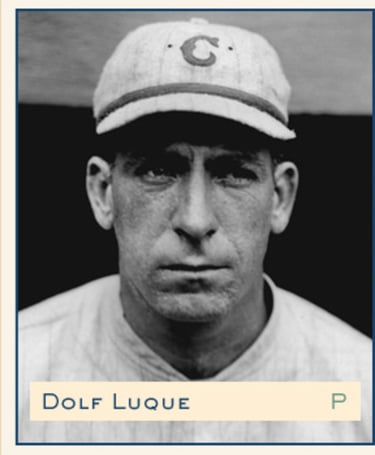
Dolf Luque: He Came First
Today's Major League Baseball rosters are filled with Latin ballplayers. In fact, the latest statistics document that Latin or Hispanic players make up 28.5% of all players. These individuals are of course some of the most gifted talents in the game so much so that one wonders what baseball would be like without this influx of players from the Dominican Republic, Venezuela, Puerto Rico, Mexico, Cuba and elsewhere. Certainly, without Latins, baseball would not be at the highest performance levels.
When most baseball fans look back to the rise of Latin ballplayers in the MLB, they usually concentrate on the 1950s with names such as Roberto Clemente, Juan Marichal, Luis Aparichio, Minnie Minoso and others. Of course, those players left an important contribution to the game not only through successful personal statistics but more significantly as trailblazers who sought to bring baseball to social and racial justice norms.
Unfortunately, few fans have ever heard of Adolfo "Dolf" Luque and most don't realize that he surprisingly played during an unfortunate time in baseball history where the color of one's skin meant everything.
Where other Latin players were not allowed into baseball during the color line ban era as their appearance was perceived as "too dark" by the white baseball power elite, Luque was the exception. It is probable that his ancestry (which was primarily Spanish and German) also included Negro lineage as was common in Cuba. However, Luque had blue eyes and a light skin tone, one that did not strike fear into the segregation mindset.
Sadly and strangely, Luque might have been more appreciated by baseball fans and scholars if he in fact had played in the Negro Leagues. It is shameful that Luque has been consistently ignored by baseball's veteran committee if not branded as not qualified for Hall of Fame consideration just because he played with white players when most of his Latin peers instead played with black ballplayers. In this analysis, Luque suffers from a weird if not misguided reverse discrimination of sorts, one that has robbed him from the accolades that he so rightfully deserves.
Luque had a rather amazing baseball record with a long career in the majors from 1914-1935, the majority of service time on the Cincinnati Reds who were often in the lower tier of the National League standings. Yet even so Luque amassed a 194-179 record with 206 complete games including a league leading won loss record of 27-8 in 1923.
But as was typical for the day, Luque was often stereotyped by media as that "crazy hot-tempered Latin." The reference for this slur evidently originated from an incident in 1923. While pitching against the New York Giants, Luque had been severely taunted by outfielder Casey Stengel over the course of several innings. Finally, Luque had enough. He calmly placed down his glove and hat and then flew into the Giants' dugout, attacking Stengel and beating him to a pulp. Even the other Giants ballplayers who realized that Stengel had gone too far did not intervene.
If one can make the case for Eppa Rixey, a fellow pitcher and long-time Reds' teammate from the era with a similar though only slightly better record, being in the Hall of Fame then certainly one must wonder why Luque is not there also. Hopefully, in the near future the morons at Cooperstown will actually correct the omission and do something right for a change, though I won't hold my breath.......