america's best baseball card game!
1920 Wirephoto Tells A Sad Story
Blog post description.
12/12/20253 min read
1920 Wirephoto Tells Sad Story
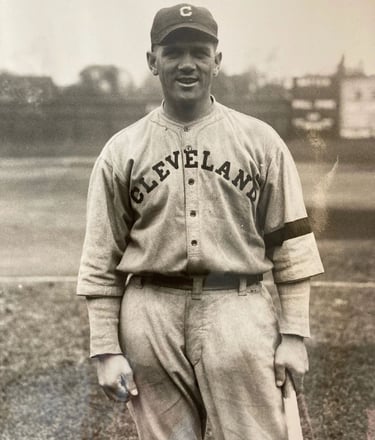
Wire photos, taken by professional news agency photographers, capture baseball history in unique ways and are highly collectible. These photos range in odd sizes from about 4 x 5 to 8 x 10 and backs show a press service ink stamp and typed paragraph or handwritten pencil notes identifying the player and game situation.
This is a United Press International photo of Cleveland Indians catcher Steve O’Neill distributed to newspapers around the country in 1920. O’Neill is wearing a mourning band of black crepe on his left sleeve.
Cleveland in 1920 was a powerful club led by player manager Tris Speaker and Stanley Coveleskie, a workhorse spitball pitcher with pinpoint control. On August 16, the Indians were one game up in the standings and starting a series against the second place Yankees at the Polo Grounds.
Considering the game’s importance, Yankees ace Carl Mays was moved up a day in the rotation to draw the assignment. He was gunning for his 100th career win. Mays was a right-handed submarine-style pitcher whose pitches dipped and curved. He wasn’t afraid to throw high and tight and push the batter back. That’s what he did in 1918 when he hit Speaker so hard on the top of his head that the ball ricocheted into the grandstand.
As the fifth inning opened, Mays and the Yankees were down 3 to 0 thanks in part to a second inning solo homer by Steve O’Neill. At the plate was 29-year-old Indians shortstop Ray Chapman. He was one of the league’s top fielders and a speedster who could get hit and run plays started. Batting .303, 1920 was shaping up to be Chapman’s best season ever.
On the mound, when Mays went into a circle windup for the first pitch with his pitching hand down close to the ground, he spotted Chapman’s right back foot shifting as if to bunt. Mays made a split-second decision to go high and up.
Mays thought the ball hit the bat handle with a loud crack and tossed the ball over to Wally Pipp at first. Pipp turned to throw around the horn but stopped when he saw Chapman crumpled at home plate. Teammates carried Chapman to the clubhouse in centerfield and an ambulance rushed him to the hospital.
Mays stayed on the mound throughout the incident and retrieved the ball. He showed umpire Tommy Connolly a rough patch on the ball which he said caused it to sail. Connolly removed the ball from play but promptly mixed it up with other used game balls.
Mays kept his composure and retired the Indians in order in the sixth, seventh and eighth before being replaced by a pinch hitter. After the game he told his teammates the ball was in bad shape and he “was as a wild as a hawk like I always am when saved up for a special game.”
At the hospital, Chapman was unconscious. Several years earlier, Chapman had told his sister that “Carl Mays dusts you off the plate. But I’ll stand right up there. He doesn’t bother me.” Now, a few hours after an emergency operation, Ray Chapman was gone.
“Chappie” was a big favorite among teammates. His best friend, Speaker, fell into depression. A Protestant, Speaker was also disappointed that Chapman became a Catholic on his death bed and as funeral plans were announced engaged in a fist fight with O’Neill who was a devout Catholic. Speaker didn’t attend the funeral and O’Neill was so choked up he fainted at the Mass.
There had been beaning fatalities in the Southern League (1916) and New England League (1906) but never a death in major league baseball. The Browns, White Sox and Senators all threatened to run Mays and his underhand style of pitching out of baseball. They subsequently backed down without proof of intentional harm.
Remarkably, Speaker was able to pull the Indians together. He hit .388 and O’Neill hit over .300 (.321) for the first time in ten years. The Indians won the pennant with a 98-56 record and beat Brooklyn in the World Series 5 games to 2.
In 1921 spring training, Cleveland batters experimented with leather football helmets but rejected the notion before the season.
Mays was branded a dirty player and forever subjected to jeers and catcalls. Nevertheless, he played for nine more years and compiled a stellar career record of 207-126 and a 2.92 ERA. He said there was no way he could play so well without a clear conscience. The pitch was an accident. Still, Carl Mays was never seriously considered for the Hall of Fame though his statistics compared favorably to many inductees. He knew why: “nobody ever remembers anything except I threw that pitch that caused a man to die.”
Steve O’Neill’s playing career ended as a member of the Yankees in 1925 but he eventually came back to Cleveland as the manager. In 1945, O’Neill won his second World Series as manager of the Detroit Tigers.
According to a Chinese proverb, a picture is worth a thousand words.