america's best baseball card game!
1912-1913 United States Baseball League
Blog post description.
12/9/20257 min read
1912-1913 United States Baseball League
Ever heard of the United States Baseball League (USBL)? Most people including casual SABR-ites and other baseball historians have not. The USBL was a short-lived hopeful baseball major-league that was established in 1912 and barely lasted only two partial seasons.
Statistics and overall history for the league are scant and are still being investigated and uncovered mainly through an examination of available newspaper articles. With that said, since the USBL was for the most part considered far inferior to the existing American and National Leagues, many papers of the day refused to send regular sports reporters to games.
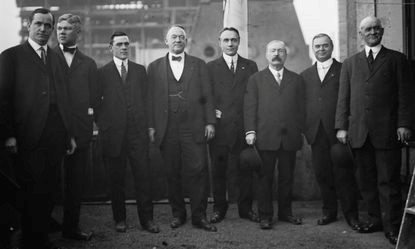
Here is what we do know. The USBL was organized in a meeting in New York’s Hotel Imperial in March of 1912. Teams were awarded to the cities of Chicago, Cincinnati, Cleveland, Pittsburgh, New York, Reading (PA), Richmond (VA), and Washington, DC. The league President was William Witmann who was the Mayor of Reading and the franchise owner for its team.
In an attempt to avoid conflict with Major League Baseball, the League issued the following statement (which of course would not have worked even if the USBL had been successful): We do not regard ourselves as outlaws, and if we are left alone we will get along without any friction with the other leagues. We will make no effort to secure players who have contracts with other clubs, neither will we form a haven for dissatisfied or suspended ballplayers…if any war is started it will have to be against us, rather than by us. I see no reason why another league cannot be carried on in perfect harmony with the leagues already in the field.”
Unfortunately, the League met with immediate problems including weak leadership, poor financials, dismal attendance and the lack of baseball players who had name recognition and prior MLB playing experience. In 1912, the USBL although scheduled to play a 126-game schedule from April 8th to September 22nd shut down after just one month of action on June 5th.
The next year, the USBL tried again with a slightly revised mix of teams, in some different cities such as Lynchburg (VA) Shoemakers, New York moved and became the Brooklyn Bandits, Baltimore Monumentals and Newark (name unknown). Original teams shifted their playing fields to new locations as was the case with the Washington, DC, team who migrated to the Georgetown area of DC (Georgetown Park). Just two total games were played in 1913 before the league folded forever. Many have suggested that the USBL was the visionary idea that gave rise to the Federal League soon thereafter in 1914.
Here is a list of ballparks for teams in the league:
Bronx Oval - New York
Exposition Park – Pittsburgh
The Fairgrounds – Lynchburg
Georgetown Park - Washington D.C.
Hippodrome Park - Cincinnati, OH. The park was also referred to as United States Park.
Gunther Park (Clark St and Leland Ave) - Chicago; now Chase Park
National Association Grounds – Cleveland
Lee Park (Moore Street and North Boulevard) - Richmond; became Boulevard Field of the Richmond Climbers in 1917, and now The Diamond
Here are some incomplete team rosters for a few of the teams. You will see some former Major League Baseball players on the rosters:
CHICAGO GREEN SOX
Roster
Lou Gertenrich; Robert Lynch; Ed McDonough; James McDonough; Tom McGuire; Henry Paynter; Al Schall; Jim Stanley
Manager
Burt Keeley
Owner
William C. Niesen
History
Under manager Burt Keeley who pitched for the MLB Washington Senators, and owned by William C. Niesen, the Green Sox of Chicago played their games out of Gunther Park which was, and still is, located at Clark Street and Leland Avenue, which was just 11 blocks from Wrigley Field. Big name players for the Sox included Lou Gertenrich, Tom McGuire, Jim Stanley, and Ed McDonough, all of which played in the pros. Chicago held a 10-12 record at 6th place in the USBL standings.
CINCINNATI PIPPINS
Roster
Fred Badel (right fielder); James Barton (second base); Lovell Draper (pitcher); Molllerkamp (first base); Dieman (shortstop); Lutz (third base); Chapman (left fielder); Doshner (pitcher); Winter (center fielder); Kline (pitcher); Albert Decker; Bugs Raymond; Ritter; Leo Witterstaetter
Manager
Marty Hogan/Hugh McKinnon
Owner
John J. Ryan
History
The Pippins of Cincinnati were owned by John Ryan, a former pitcher for the Baltimore Monumentals in 1884. The Pippins had 2 managers, first Marty Hogan (major leaguer for the St. Louis Browns and Cincinnati Reds) and then Hugh McKinnon. Reasons for Hogan's replacement are unsure, because the New York Times in April 1912 stated first that Hogan would be manager, but several days later the Times stated it was McKinnon. Cincinnati quit on June 3, after posting a 12-10 and in 4th place when it all ended. Little information is known about them.
CLEVELAND FOREST CITY
Roster
Joe Delahanty; J. Duff; Sam Duff; Jerry Freeman; Jack O'Connor; Hal Rafferty; Charles "Silk" Kavanaugh
Manager
Jack O'Connor
Owner
William Murphy
History
The Forest City played under Jack O'Connor, former major leaguer with 7 different teams. Their owner was little known William Murphy. If anything was known about Cleveland, it was that they issued light-green schedule cards. Notable players include major leaguers Joe Delahanty, Jerry Freeman, and Jack O'Connor. Cleveland disbanded from the league on May 22. After 21 games, the Forest City stood 8-13 and 7th in the league, to only the New York Knickerbockers.
NEW YORK KNICKERBOCKERS
Roster
Joe Wall; Alonzo Cook
Manager
William Jordon
Owner
Charles White
History
The New York Knickerbockers were one of the USBL's biggest fails right from the start. On Opening Day on May 1, 1912 in the Bronx Oval, New York and Reading battled to a 10-10 tie (called due to darkness), after the score was tied 7-7 after 9. Around 3,000 fans showed up, including league president William Witman and many other owners of the USBL clubs. Those fans should have been happy with the result, because Knickerbockers success would not last long. In fact, only another day. New York next loss to Reading 6-2, then again on May 3. After 17 games, the Knickerbockers stood last in the league at 1-15-1. At one home game against Chicago, nearly 50 people showed up. As attendance decreased to almost nothing, Chicago forfeited a game against them. New York folded from the league, doing so on May 28. The last game they played was supposed to be against Chicago, but was cancelled. It was as if New York (along with some Eastern teams) were in a completely different league than the USBL's western squads. The next year in an attempt to recreate the USBL, New York lasted a stellar 24 hours.
PITTSBURGH FILIPINOS
Roster
Red Callahan; Harry Johns; Deacon Phillipe; Frank Rapp; Claude Ritchey; Harry Symes; Henry Warren; William West
Manager
Deacon Phillipe
Owner
Marshall Henderson
History
The Filipinos, much like the Richmond Rebels, were one of the few successful USBL teams. The name "Filipinos" was in honor of Pitt's manager, Deacon Philipe, a former major league pitcher for the Louisville Colonels and Pittsburgh Pirates. The Filipinos were at the top of the standings with a 19-7 record at season's end. Pittsburgh was owned by Marshall Henderson and William McCullough. Big name players for the Pirates along with Philipe included Claude Ritchey, MLB infielder and outfielder for the Cincinnati Reds and the Pirates. Pittsburgh played at Exposition Park looking towards the Allegheny River. The next year in 1913, the Filipinos joined the Federal League, but were later renamed the Stogies the same year.
READING
Roster
Leo Groom (pitcher); Jack Cronin (pitcher); Charlie Malay (left fielder); Charles Dysert (right fielder); Jimmy Sheckard (center fielder); Brouthers (second base); Edward Sabrie (first base); Jack Himes (first base); Dieter (third base); Manning (shortstop); J.E. Porte (catcher); Fletcher (pitcher); Milliman (outfielder); Jackson (pitcher); A.E. Pettit
Manager
Leo Groom
Owner
William Witmann
History
The Reading baseball team was owned by the triple-threat William Abott Witmann, and manged by Leo Groom. Witmann was not just the owner of Reading, but the owner of all the United States Baseball League and he was owner of Reading, PA. They called the Fairgrounds of Reading, PA their home. On May 1, opening day, Reading took the field in blue-gray uniforms bearing a white R on the sleeves. They fought to a 10-10 tie with New York. The next day, they won 6-2, and again on the 3rd. They abandoned the league on May 30, and court papers were filed June 1 when Reading was near bankruptcy. When the league folded, Reading stood at 12-9, 3rd in the standings. Witmann and the league didn't want to go down. In 1913, with 6 new teams formed, Witmann ordered the construction of 7,000 seat "Lauer's Park". They were still missing one thing that they would never get- a team to play in it.
RICHMOND REBELS
Roster
William Prout (second base); Socks Seybold (right field); Bert Blue (catcher); Patrick Bohannon (first base); Hermas McFarland (center field); Tom O'Hare (left field); Fritz Hoffman (third base); Alfred Newman (shortstop) not to be confused with Alfred E. Newman of Mad Magazine fame; Bill Taylor (pitcher); Daniel McAleese; Cyrus Clyde; Hugh Haggerty
Manager
Alfred Newman (again not THE Alfred E. Newman)
Owner
Ernest Landgraf
History
The Rebels played on opening day in front of over 2,000 fans as they beat the Senators 2-0. The players were positioned that day exactly as they are shown above. Unlike many of the USBL teams, the Rebels consistently had fairly strong attendance and managed to win. On the 2nd, Richmond defeated Washington yet again in front of around 3,000 fans. Richmond called Lee Park their home in the one and only year of existence. Big time major league players for them included 41-year old Socks Seybold, who previously played for the Philadelphia Athletics, along with Bert Blue, a catcher also with the A's but had little experience. The Rebels, however, were also in an in-city battle with fellow club Richmond Colts of the Virginia League. The players down at Broad Street Park were drawing thousands for their games just like the Rebels. But it wouldn't last for long. Teams were dropping out of the USBL one after the other, most for financial reasons. By this time, the league didn't even have an official schedule. Teams played each other at will in an attempt to make money. The final game for Richmond and for the USBL occurred on June 26, 1912, when the Rebels played the "Collegians", an independent team, with proceeds going to players. The attendance was much lower than the expectations.
WASHINGTON SENATORS
Roster
Francis "Big Jeff" Pfeffer (pitcher); George Browne (right field); John Patience
Manager
George Browne
Owner
Hugh McKinnon
History
Not to be confused with the previous National League and American Association baseball team, the Washington Senators were lead by skipper George Browne, former Major Leaguer for the Phillies, (New York) Giants, (Boston) Doves, Cubs, Senators, White Sox, and (Brooklyn) Dodgers. They were owned by Hugh McKinnon, who later become the Pippins manager for unclear reasons. The Senators quit the USBL on the 27th of May. By the partial year's end, the Senators stood 6-7, which was the fewest number of games played by any team, which included a 2-0 loss at Richmond's Lee Park on opening day. They finished 5th in the league. A very notable Senator was Francis "Big Jeff" Pfepper, a pitcher for the Cubs, Boston Doves, and Boston Rustlers. Washington, however, played another exhibition game against Cincinnati on May 26, losing 6-3 in front of over 1,500 fans.